How Did Gericault Talk About Particular Conditions of Human Life in His Art Work
"The truly gifted individual does non fear obstacles, because he knows that he can surmount them; indeed they often are an boosted asset; the fever they are able to excite in his soul is not lost; it fifty-fifty often becomes the cause of the most astonishing productions." ~ Théodore Géricault
The Raft of the Medusa is not an like shooting fish in a barrel painting to study or appreciate, but it deserves our attention; for we can larn much from the existent-life tragic event that inspired it, as well as the feverish dedication and skill with which it was painted.
Measuring a whopping 23 by 16 feet, this ballsy oil on canvas masterpiece now hangs in a gallery nigh the Mona Lisa in the Louvre, Paris.
Le Radeau de la Méduse was Théodore Géricault'southward most famous and shocking work of fine art.

Le Radeau de la Meduse by Théodore Géricault c. 1818-19
The Raft of the Medusa portrays a brief moment of euphoria as the men on the raft spot another ship in the distance, hoping and praying to be rescued later xiii horrific days at sea.The Argus can only just be seen on the horizon.

You can almost hear the men's hoarse cries in an attempt to describe attending to their desperate plight, mustering their last ounce of strength to shout and wave a stained, ripped shirt. This is their last hazard of survival…
Théodore Géricault, a courageous, passionate, Romantic era French painter and lithographer, sadly passed away from tuberculosis at the tender historic period of xxx three. Géricault didn't alive long enough to see his paining achieve its greatness, but that seems to be the way of things for many artists and creatives.
Probably the ghost of Vincent van Gogh would be flabbergasted (merely happy), to know the sums of money passing hands for his prized paintings; or of his universal popularity and posthumous fame. Notwithstanding of the prolific oeuvre of 900 paintings he produced in his lifetime, he sold only ane: Red Vineyard at Arles.
It is a curious phenomena. Many artists, composers and writers were nether appreciated or misunderstood in their prime… In the spirit of originality they were only being true to themselves, following their inner compass, regardless of the trends, thoughts and fashions of the time.
Who knows what Géricault might accept produced had he been gifted with a few more years to bestow his creative talent on the world. But in my humble opinion he has earned a place at the table of the greats with this heart-rending work.
The Raft of the Medusa depicts the harrowing and calamitous historical outcome of the sick-fated voyage of the French Navy'due south 40 gun Frigate Méduse, carrying around 400 passengers (including the new Governor and his wife), plus various French officials who were en-route to reclaim Senegal from the British.

Wreck of frigate Méduse
The Méduse ran aground on the Bank of Arguin off the coast of Islamic republic of mauritania in the summer of 1816. The shipwreck and its raft tragedy elicited considerable public emotion, making Méduse 1 of the almost infamous shipwrecks of the Age of Sail.
An incompetent captain
Viscount Hugues Duroy de Chaumareys was installed as ship'south captain by King Louis XVIII in a political manoeuvre because of his support for the monarchy after the Bourbon Restoration.
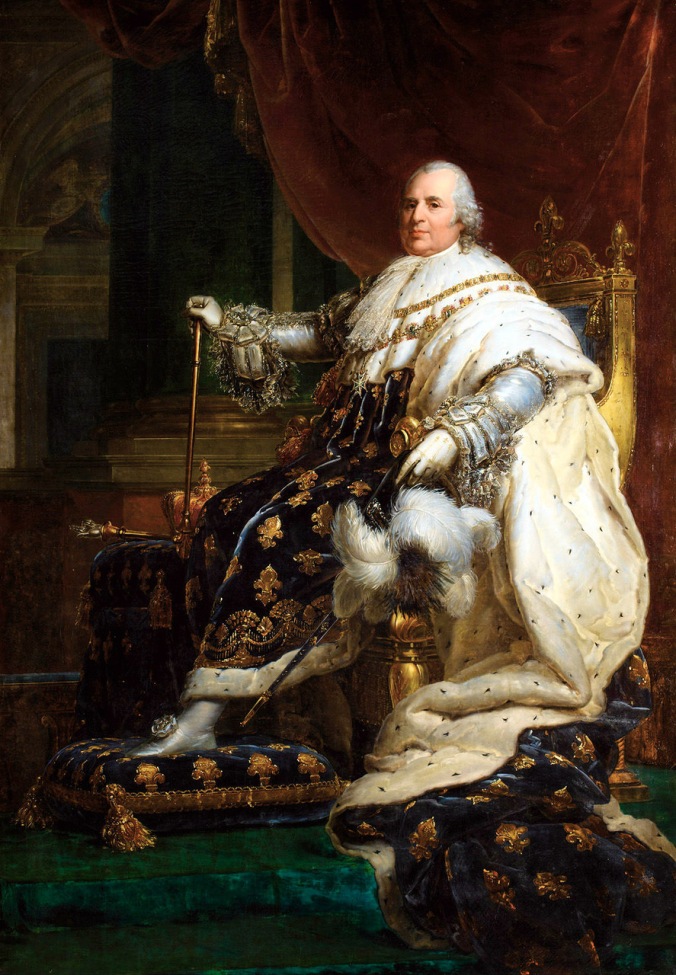
Louis Eighteen of France in Coronation Robes by Francois Gerard
The rex overlooked the fact that he had inappreciably sailed for twenty years, and was clearly unsuitable for the posting. It was an act of unparalleled hubris by the French monarch, as Monsieur de Chaumareys proved himself to exist incompetent and grossly negligent for the unnecessary deaths of many of his passengers and crew.
The Méduse was not the offset vessel to not acquit enough lifeboats for all its passengers, and sadly it has not been the concluding. In that location were merely enough lifeboats to arrange 250 passengers on the voyage should the need arise. And arise it did.
In his attempt to print the new governor and of import guests, the helm sailed too fast and too close to the shore (ignoring the warnings of a senior crew member), in his bid to make it at their before the accompanying vessels. Inevitably, the Medusa struck a large sandbank.
Possibly the ignominy made too big a dent in his pride, as de Chaumareys refused to offload the heavy cannons on board the Méduse and so she could be re-floated. Another unconscionable conclusion with others to follow that would price more lives.
Stranded off the W African coast, the Méduse listed helplessly. Initially, it was decided that the lifeboats would make two return runs to shore (around thirty miles abroad) in order to get everyone to safety, and a raft was hastily built, xx metres long and 7 metres wide, to transport the ship's cargo.

Raft of Méduse at the moment of its abandonment by Alexandre Corréard
However, inclement weather whipped up a tempest that hitting them on vth July 1816 and the captain, fearing the Méduse would intermission apart, gave the order to carelessness ship. Seventeen soldiers and crew remained on the ship in club to protect her cargo, while 250 passengers were placed in the lifeboats and 147 souls were packed like sardines onto the raft, which was beingness towed by the lifeboats.
Human nature always seems to exist either at its worst or its best during times of crisis, and at that place does non appear to be whatever signs of heroism emerging from this particular historical debacle.
The people in the lifeboats (maybe fearing for their own lives), cut the ropes towing the raft after a bit, and with barely any food, drinkable or life sustaining supplies and no manner of steering or navigating, the raft drifted into the swell of the Atlantic…
The apparent cruelty and callousness with which they were jettisoned by the passengers in the lifeboats would unleash hellish conditions and unbridled panic on the unfortunate men (and ane woman) clinging to the raft, as they apace perished through drowning, starvation, suicide, disease, fighting and murder.
Although shocking, it's probably not surprising that some of them somewhen resorted to cannibalism.
The center of the raft was the safest place and fierce attacks broke out equally the men clambered and fought to be away from the exposed edges, the prowling sharks and the unforgiving waves…
After thirteen days of beingness tossed effectually at sea, one of the accompanying ships, the Argus, saw and after rescued the survivors from what was left of the raft. They found only 15 men left alive from the 147, and a farther 5 of these died when they reached land, including the last African crew member, Jean-Charles.
Suddenly, here was a historical painting not of heroic deeds, not drawn from aboriginal Greek or Roman mythology, but of real people struggling with a contemporary disaster, shown to the French nation in the form of Géricault's brutally visual social commentary on the tragedy.
To add insult to injury de Chaumareys sent a save coiffure back to the Méduse to recover her cargo of gold. The transport had non been broken apart as he had thought, but remained intact, with only 3 of the seventeen men who stayed aboard still alive afterward 50 four days.
During his court martial in 1817, de Chaumareys was acquitted on three counts: of abandoning his squadron, of declining to re-float his transport and of abandoning the raft. Notwithstanding, he was found guilty on ii counts: of incompetent and complacent navigation and of abandoning the Méduse earlier all her passengers had been taken off.
The verdict carried a potential death penalty, only de Chaumareys was sentenced to but three years in jail.
However, I practice feel the British must take had their fair share of bumbling idiots put in unsuitable positions of power and responsibility by favour of royal or noble patrons, without due consideration to the consequences of their actions.
Even though The Raft of the Medusa must have highlighted further the embarrassment and subsequent attempt to cover-up the shipwreck by the French monarchy, its sizeable depiction on canvas was nonetheless displayed at the prestigious Paris Salon in 1819.

Raft of the Medusa shown in Salon Carre of the Louvre depicting Gericault's painting on display by Nicolas Sebastien Maillot c. 1831
King Louis 18 commented: "Monsieur Géricault, y'all've painted a shipwreck, just it'due south non i for y'all."
Its grisly, visual storytelling wasn't so far removed from the tenets of the Romantic Movement: to agitate emotions, feelings and passion; reacting confronting absurd, hard logic and depicting individuals in peril. Although Romantic in genre in that location is nonetheless an chemical element of Classicism in the piece of work.
The underlying theme of Romanticism was that non everything could exist understood.
"Feel the forces of nature in all of their grandeur and power and so you feel insignificant. Only and then tin can you lot feel role of something bigger." ~ Edmund Burke
People were smaller parts of a larger, mysterious whole; usually painted at the mercy of the forces of nature in wild and untamed landscapes.
Romantic art works were designed to make people feel overwhelmed , and I think when we look at this painting, the best word to describe the Raft of the Medusa is overwhelming….
Géricault grafted and crafted a work that was overwhelming in subject matter beyond anything that had been painted by anyone before. Information technology confronts us with strongly visceral material: physical, mental and emotional suffering, all the more than poignant for its tiny element of hope.
Despite the painting's similarities with the historical issue it portrays, there are notable differences. For all its authenticity, Géricault may take decided to heighten the drama for aesthetic considerations. There are more than people on the raft in the painting than there were left in real life, and the weather was sunny and calm on the day of the rescue, not brooding and stormy. But we'll forgive him for taking such artistic licence!
"With the brush nosotros merely tint, while the imagination lone produces colour." ~ Théodore Géricault
The entire Raft of the Medusa project was completed by Géricault in eighteen months.
The right hand triangle of tangled, contorted bodies is crowned by a black man, waving a makeshift flag at the transport on the horizon. Perhaps he was also commenting on slavery, as well as the want to survive, for Géricault was an Abolitionist.
The scene is dark, it does not hide the madness, desperation and death that these souls experienced, just Géricault still manages to impart some artful beauty into the work. The figures are obviously Baroque in their physical appearance, muscular and of the type you might see in a painting past Peter Paul Rubens (who was a major influence on Géricault).
The lighting is somewhat "Caravaggesque", after the Italian artist closely associated with tenebrism—the apply of violent contrast between light and nighttime.
It could exist said that there is also the influence of Michelangelo if you study the detail of the underworld from his immortal Renaissance masterpiece, the Last Judgement on the Sistine Chapel.

Particular of The Terminal Sentence by Michelangelo
"Michelangelo sent shivers up my spine, these lost souls destroying each other inevitably conjure upward the tragic grandeur of the Sistine Chapel." ~ Théodore Géricault
A literary influence is also prominently on brandish in the painting, Géricault's clever manner of making the viewer question what they would do in a similar situation. He does this by depicting a character from a well-known story to his audience of the time: Count Ugolino from Dante's Divine Comedy .

It is idea he 'borrowed' the image from a painting of Ugolini by Henry Fuseli (1741–1825).

Ugolino and his sons starving to death in the belfry by Henry Fuseli c. 1806
We see the dolorous, mature, grey haired homo, scarlet scarf draped over his head, his correct elbow on his knee, sitting hunched in grief and resignation with his left arm resting over his dead son.
Géricault is asking u.s.a. through these figures representing Count Ugolino and his lifeless son: is hunger stronger than grief?
In Inferno, Dante writes that the prisoners were slowly starved to death and before dying Count Ugolino's children begged him to eat their bodies.
"'Male parent our pain', they said,
'Will lessen if you eat u.s.a. you are the one
Who clothed united states with this wretched flesh: we plead
For yous to be the one who strips information technology away'.
(Canto XXXIII, ln. 56–59)
"… And I,
Already going blind, groped over my brood
Calling to them, though I had watched them die,
For two long days. And then the hunger had more
Power than even sorrow over me"
(Canto XXXIII, ln. 70–73)
Research in a higher place and across the telephone call of duty!
In his quest to brand an impact and accurately depict the events that took place on the raft of the Medusa, Théodore Géricault first read damning newspaper accounts in the Periodical des débats which appeared on 13 September 1816, then contacted two survivors from the shipwreck: the cartographer Alexandre Corréard and surgeon Jean-Baptiste Henri Savigny.
They had co-written a volume nigh their ordeal and agreed to meet him and relay their traumatic experiences. He put them up in his home during this fourth dimension.
Géricault learned that the send's carpenter had likewise survived, and duly invited him to build a smaller scale replica of the actual raft in his studio. He was and then able to study the perspective of a realistic scene for his ballsy painting.

Portrait of the Carpenter on the Méduse by Théodore Géricault
And if you didn't think that that was enough, he too visited the morgue to sketch and study corpses and cadavers, then that he could accurately portray their lifeless, pallid expressions and complexions.
Géricault fifty-fifty took the unprecedented step of bringing body parts dorsum to his studio to paint. The stench of putrid mankind must have been overwhelming, not to mention the almost unpleasant and macabre nature of this undertaking.

Study of torso parts in preparation for the Raft of the Medusa
That he went to such lengths over this painting is nearly incomprehensible.

Preparatory work of The Raft of the Medusa past Théodore Géricault
Composition and construction
The majority of the raft'due south inhabitants are bundled in two pyramid type structures along with the small sheet, while the open up space at the forefront of the raft makes it seem closer and invites us to step aboard if we dare…

The way the lite shines and reflects on the living (and dead mankind), in a brief moment of euphoria as they spot a ship on the horizon is really quite eerie. The large moving ridge on the left threatens to engulf them all before they can be rescued, their state of affairs is nevertheless precarious. The sun's rays illuminating the sky from beyond the horizon offsets the foreboding dark clouds. There is non much left of the raft itself at this stage.
French Romantic painter Eugène Delacroix posed as the night haired figure lying face up downwardly at the front of the painting with his arm stretched out in front end of him.
Delacroix was a friend and gentleman of Géricault, and after painted his famous Barque of Dante forth similar thematic lines.
"Géricault allowed me to meet his Raft of Medusa while he was yet working on information technology. Information technology made then tremendous an impression on me that when I came out of the studio I started running like a madman and did not stop till I reached my ain room." ~ Eugène Delacroix

The Barque of Dante by Eugène Delacroix
The raft of the Medusa was exhibited in London in 1820 at William Bullock'south Egyptian Hall in Piccadilly, London, from 10th June until the terminate of the yr, and was seen by around 40,000 visitors. Information technology proved more popular in London, partly because it was hung low to the footing (different at the Salon where its high position lessened its monumental affect).
Influences onGéricault for The Raft of the Medusa
French contemporary artists that would have left their marker on Géricault and influenced his approach and execution of the Raft of the Medusa, were Jacques-Louis David, Antoine-Jean Gros and Pierre-Paul Prud'hon.
From Wikipedia:
Several English language and American paintings including The Death of Major Pierson by John Singleton Copley (1738–1815)—likewise painted inside two years of the event—had established a precedent for a contemporary subject. Copley had likewise painted several large and heroic depictions of disasters at ocean which Géricault may have known from prints: Watson and the Shark (1778), in which a black man is central to the action, and which, like The Raft of the Medusa, concentrated on the actors of the drama rather than the seascape;

Watson and the Shark by John Singleton Copley
The Defeat of the Floating Batteries at Gibraltar, September 1782 (1791), which was an influence on both the fashion and subject matter of Géricault's work; and Scene of a Shipwreck (1790s), which has a strikingly similar composition. A further important precedent for the political component was the works of Francisco Goya, particularly his The Disasters of War serial of 1810–12, and his 1814 masterpiece The Third of May 1808.
Jean-Louis André Théodore Géricault (1791 – 1824)
Born in Rouen to a wealthy family, young Theo was first educated in his art past the painter Carle Vernet, in the sytle of English language sporting art. Many of his earlier works were mostly of horses or with a military theme, and sometimes combined both.

Théodore Géricault in his studio c. 1818
He was immune to paint the magnificent horses in their stables at Versailles. Pierre-Narcisse Guérin taught him classical figure limerick, but Géricault decided to self-straight his education at the Louvre from 1810 to 1815, copying works by Rubens, Titian, Velázquez and Rembrandt.
His last works were a series of x paintings of the insane, the patients of a friend, Dr. Étienne-Jean Georget, a pioneer in psychiatric medicine, with each subject exhibiting a different affliction. 5 are known to have survived, including the Insane Woman. 'Les monomaniacs' portraits are subtle and brilliantly nuanced.
Interesting history of the artist by Dr. Christian Conrad:
In add-on to his influence on Delacroix, Géricault'south piece of work had an of import effect on Edouard Manet and the future impressionists. JMW Turner even strapped himself to the mast of transport to experience being out in a storm in the quest for authenticity!
Géricault could be considered the pivotal founding figure of modernistic art.
The upshot and the painting inspired the High german composer Hans Werner Henze, who wrote a suitably epic oratorio on the subject, Das Floß der Medusa.
The powerful presence and authenticity of this work; its scope, its grisly subject matter and enthusiastic, atmospheric rendering will ensure the Raft of the Medusa remains in the cannon of humanity's greatest fine art works.
All I can say is I'thou glad I wasn't there! Thankfully lessons were learned from this tragic episode of French Maritime history. The Gouvion de Saint-Cyr Law ensured that promotions in the French military would thereafter be based solely on merit.
"Our whole society is aboard the raft of the Medusa." ~ Jules Michelet
Source: https://rhapsodyinwords.com/2018/03/08/whats-in-a-painting-taking-a-closer-look-at-theodore-gericaults-masterpiece-raft-of-the-medusa-c-1818-19/
0 Response to "How Did Gericault Talk About Particular Conditions of Human Life in His Art Work"
Post a Comment